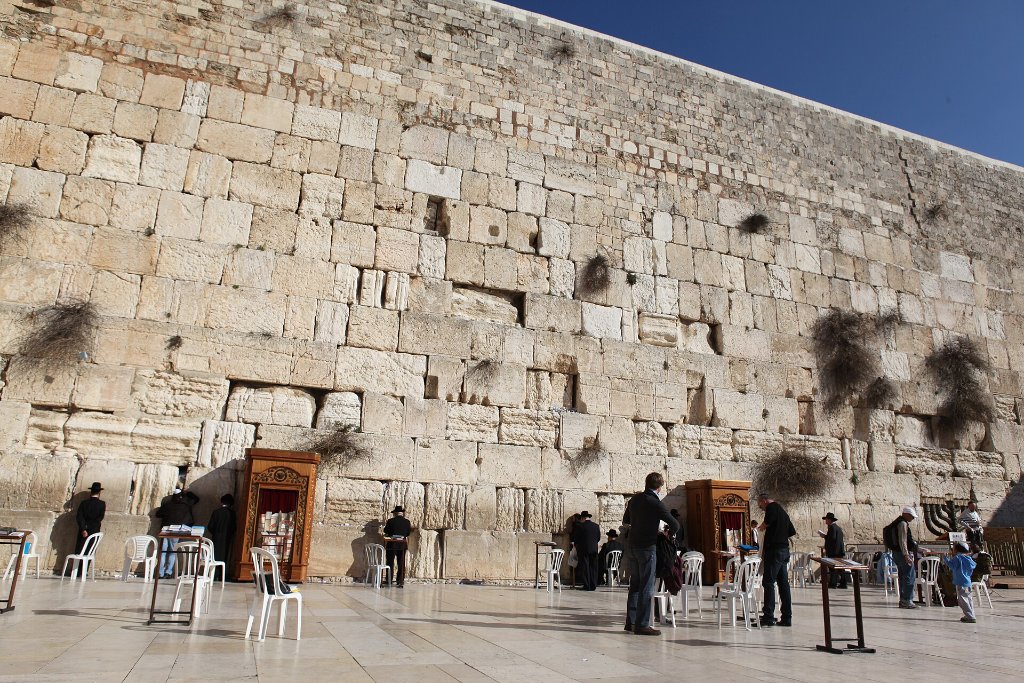
Jerusalem's holiness to the three monotheistic religions is something we take entirely for granted. But where does it actually come from? This essay rolls the answer backward through time — from Islam, through Christianity and Judaism, all the way to the Middle Bronze Age — to reveal a surprising and forgotten origin buried beneath the Temple Mount itself.
Okay, this is turning out a bit longer than planned. But we have a lot to cover! Ready? This is going to be extremely interesting…
Jerusalem — the city holy to the three monotheistic religions. On the surface, what could be more obvious? It is a fact we take for granted, never stopping for even a moment to think about it. And why should we? So much happens around this "Holy Basin" — politically, religiously, and socially — that the idea of not taking this fact for granted borders on madness.
And yet, let us pause for a moment — if only for the sake of appetite and healthy curiosity — to wonder about the true nature of this city. To do so, we shall ask (and eventually attempt to answer): what is the source of this holiness?
Let's roll the answer backward, through the (relatively) recent past to the ancient past, as we review the sources of Jerusalem's sanctity through the lens of the three monotheistic religions that place it at the head of their joy.
Islam - 1,400 Years Ago
First, we begin with the religion closest to our time: Islam. A detail often mentioned regarding Islam's relationship to Jerusalem is that the city's name does not appear within the pages of the Quran — and this fact is, of course, correct.
However, in Muslim tradition, it is accepted to view two Surahs mentioning two events as referring to Jerusalem: Al-Isra (The Night Journey) and Al-Mi'raj (The Ascension). These two Surahs connect two journeys — the first horizontal, and the second vertical.
In the verses of the first Surah, the horizontal one, it is mentioned how Muhammad, the last prophet and messenger of God in Islamic tradition, undergoes a magical night journey from the Sacred Mosque to the Farthest Mosque. This reference is short and does not elaborate much beyond that. But in the Hadith tradition — where accounts of the Prophet's actions and words were recorded — it is accepted that this Farthest Mosque is Al-Aqsa Mosque in Jerusalem, its name literally meaning The Extreme Mosque.
The second Surah, the vertical journey, tells of Muhammad's ascent to heaven. During this ascent, Muhammad passes through the seven heavens, meeting several familiar figures from Jewish and Christian tradition: Adam, Joseph, Jesus, Enoch, Abraham, and even Moses — and finally, Allah Himself, who at that moment grants him the commandment of the Muslim prayer, the Salah.
However, these two traditions are relatively late. We must therefore consider another, highly interesting tradition: the tradition of Judgment Day. According to this tradition, when history comes to an end, Allah will judge the souls of all creatures. Some will be sentenced to Jahannam (Hell) and others to Jannah (Paradise). The tradition says the judgment will take place over a thread stretched between the Mount of Olives and the Temple Mount. Souls will be asked to cross it; the heavy souls of sinners will fall into the Kidron abyss, while the pure souls of the righteous will reach the Temple Mount safely and merit dwelling in God's blessed plot forever.
Anyone who has read even a few chapters of the Quran will quickly understand the importance of this tradition. Many Surahs touch upon Judgment Day repeatedly, reminding believers that Allah is the only power acting in the world. The subject of the Last Judgment carries great theological weight; therefore, a tradition linked to Judgment Day is equally significant.
Christianity - 2,000 Years Ago
In Christianity, the answer is much simpler. The Temple Mount is not important. Not important at all. How unimportant? So much so that after the Roman Empire converted to Christianity and the Byzantine period began, the Temple Mount and the site of the Temple were filled with refuse, effectively becoming a garbage dump.
That is to say, the Christians in Jerusalem celebrated the victory of Christianity over Judaism. But inadvertently, by doing so, they actually did grant the Temple Mount special significance — derived from its designation as the formerly holy place, contrasted with the new holy place: the Church of the Holy Sepulchre.
The Christian dogma clarifies this perfectly. According to Christianity, the Temple Mount was once the site of the covenant between the People of Israel and their God. According to tradition, it was also the site where Abraham was asked to sacrifice his son. But eventually, God grew weary of His people and nullified the importance of the altar and the covenant. Instead, He offered a New Covenant to the world, embodied in the body of Jesus, His son. The climax of the Christian covenant is God's sacrifice of His own son on the altar of the Cross. Therefore, the site of the crucifixion, Golgotha — located on the western hill of Jerusalem — is now the holy site.
Note that to emphasize the importance of the new holy site, many believers insisted on leaving the Temple Mount in ruins to highlight the covenant renewed in the Messiah. Even though the Christians sought to distance themselves from the Temple Mount, they still singled it out.
Judaism - 3,000 Years Ago
Wow, we've gone quite far back in time. It is now time to touch upon the story of Jerusalem's rising holiness in Judaism. Remember how we discovered with shock that Jerusalem isn't mentioned in the Quran? Well, we are bound to discover it again with shock — but this time regarding the Torah.
Jerusalem is indeed mentioned in the Bible (Tanakh), and many times at that. But not in the Torah itself — the Five Books of Moses — which tells the story of the nation's patriarchs. In fact, Jerusalem only receives the holiness we recognize today during the days of King David, who chose it as his capital.
And it was not an obvious choice! At the beginning of his reign, David chose Hebron — the city of the tribe of Judah — as his capital. Only later did he move his capital to Jerusalem, after conquering it from the Jebusites, an ancient people about whom we know very little.
David takes this city as his capital and builds his temple within it. The story of building the Temple is interesting in itself, as the Book of Samuel explicitly mentions how God was not interested in it. He was fine in the Tent of Meeting. But later He is convinced and willing to accept a Temple — though not from David's hands, but from the hands of his son, Solomon.
And where does David choose to build the altar? At a site where a threshing floor once stood — an agricultural structure for separating grain. A strange choice, isn't it? Granted, a threshing floor is a high place, as ancient farmers used mountain winds to separate the chaff from the grain.
Indeed, the location of the Temple Mount is a high point — a place that can also be fortified. The result is a raised city, or in Greek, an Acropolis. This wasn't an accident; ancient peoples intentionally placed the center of their cities on hills easy to fortify, with water sources, food stores, the city treasury, and of course, a temple for the local god. Just as Athens had the Parthenon on its Acropolis, Jerusalem had its Temple.
Why did David choose this specific city? There is a political explanation. David was a king who seized power from another king whom the people saw as legitimate. The capital of the previous king, Saul, was in Mizpah. David had to ensure his new capital wasn't located deep within his own tribe's territory — which might look like favoritism toward the Tribe of Judah.
What did David do? He chose a neutral city — the city of the Jebusites. There he could place his capital without upsetting the other 11 tribes. Furthermore, it was there that Abraham was asked to sacrifice his son, atop Mount Moriah.
The Middle Bronze Age - 4,000 Years Ago
The time machine doesn't stop. Now it takes us even further back — before Islam, before Christianity, and even before Judaism. We reach the period preceding the monotheistic era in the Land of Israel. Wait — it wasn't even called Israel then. It was called Canaan.
We know little about Jerusalem from this period, and what we do know comes from Egyptian sources, telling of the dynamics between the great imperial center in Egypt and the various city-states throughout Canaan.
But there is additional information — not historical, but archaeological — that finally betrays the true source of the Temple Mount's holiness.
Today, the average traveler cannot go beneath the Dome of the Rock. But those privileged to enter beneath the golden ceiling discover a perforated rock in the heart of the site — with a shaft leading into the depths of the stone.
And what is inside the rock? To solve the mystery, we can jump for a second to a nearby city: Hebron. There, too, is a similar site called the Cave of the Patriarchs (Me'arat HaMachpelah). The story of this site is mentioned in Genesis, when Abraham purchases it to serve as a burial plot for his family.
Indeed, at the heart of that site today lies an ancient burial system dating back to the Middle Bronze Age — located, believe it or not, inside a hollowed, perforated rock mass, where a shaft leads from the surface to the interior, where a large cave for burying the dead is found.
In fact, this phenomenon exists in several other sites along the mountain range of Israel, along the same north-south axis where both Jerusalem and Hebron are located.
And so, we have an answer. Ancient Jerusalem contained an ancient burial site — and burial sites serve to this day in all religions as incomparably important places of worship. In the place where the body of the deceased was laid (usually a person of great importance), their soul is also believed to reside. Those who come to pray at their burial place believe they can gain assistance — protection, health, livelihood, and more.
To Finish, a Small Note
The original holiness of the Temple Mount, rooted in a burial site from the Middle Bronze Age — predating the appearance of monotheistic religions — was hidden by many different religious narratives. But the original reason for the site's sanctity was preserved in legends and footnotes.
For example, a tradition regarding Jerusalem's prior holiness appears in Genesis 14, though it isn't mentioned by the name Jerusalem but as the city of Salem, where Melchizedek, a priest of God Most High, officiates.
But that's not all. We already mentioned the Muslim tradition of Judgment Day, where the Temple Mount is the portal to the next world. In fact, there are other similar traditions preserved in the Talmud — specifically the Jerusalem Talmud.
One tradition says the cave on the Temple Mount was unusual and used for Genizah (hiding sacred objects), including the Ark of the Covenant. According to another story, inside the cave beneath the altar was the skull of Araunah the Jebusite — the owner of the threshing floor sold to King David. A third tradition (Avot de-Rabbi Natan) states that anyone buried in the Land of Israel is as if buried under the altar, and anyone buried under the altar is as if buried under the Throne of Glory. No less.
In other words, there are several traditions scattered throughout the writings of the Sages — much later than the Bronze Age, the days of David, or even the days of Jesus — that create the impression that there was a grave beneath the altar on the Temple Mount.
The Amoraim knew. Or at least, some of them did.
Isn't it just to die for?