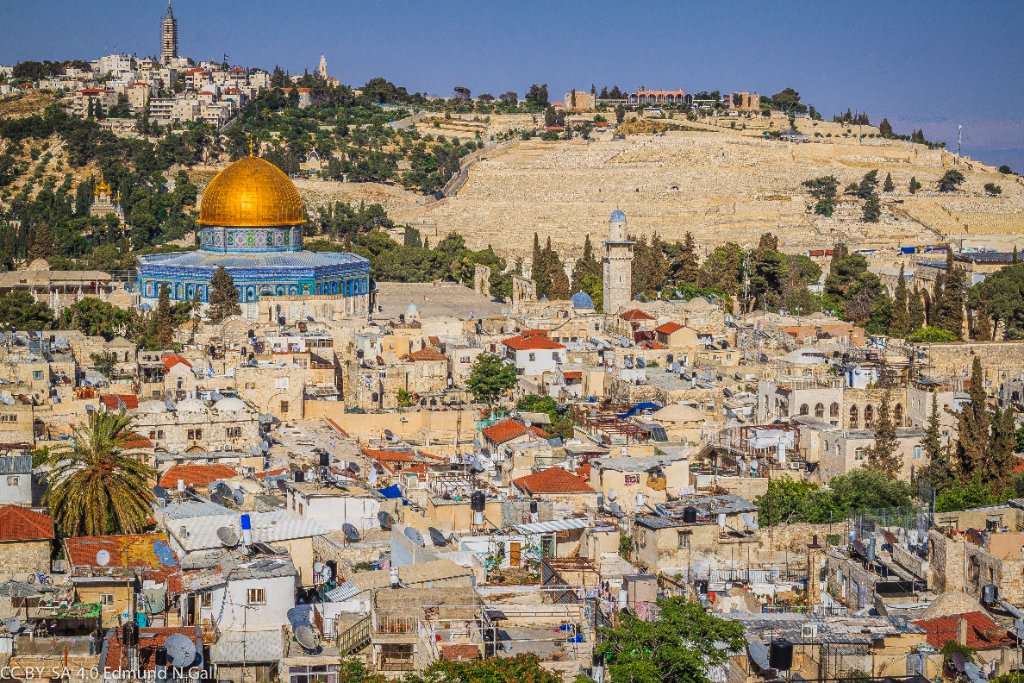
The Dome of the Rock, Jerusalem's first monumental Islamic structure, was built directly over the ruins of the Jewish Temple's Holy of Holies. This essay argues that, contrary to later traditions like Muhammad's Night Journey, its construction by the Umayyad Caliphs was a political statement and an attempt to restore a Jewish vision of the site—a "Seat for God." Driven by shared sentiment with Jewish converts and a desire for "vengeance" against Byzantium, the Dome reveals early Islam's surprising political ambitions and deepest influences.
Today, it is impossible to imagine Jerusalem without that gleaming golden dome standing out against the skyline of this 4,000-year-old city. The image is so fixed in our collective consciousness, so iconic, that the average visitor to the Old City rarely stops to ask: "Wait, why is it even here?"
It is a question worth asking. A quick glance at the architecture, the color, and the aesthetics reveals the most basic fact about the Dome of the Rock: it is a Muslim structure. But behind that simple fact lies an enigma—a riddle that scholars have grappled with for centuries.
The Mystery of the Mount
What exactly is the puzzle? The most difficult element to crack regarding the Temple Mount is the most basic: why was this specific building placed here? On the surface, it seems simple. Muslims sanctify Jerusalem and the Temple Mount; according to Islamic belief, the Al-Aqsa Mosque is located here, and thus, a structure was built.
But things are not so simple. In fact, the magnificent golden dome is not the Al-Aqsa Mosque. The famous mosque is actually located on the southern edge of the Temple Mount plaza, topped by a silver dome—far less grand than its gilded neighbor.
Here is where it gets complicated. Not only is it not Al-Aqsa, but it isn't actually a mosque at all. So, what is it? There is no clear answer. The Dome of the Rock is not a religious building of any type previously known in Islamic history. Furthermore, it was built at an almost unfathomable cost.
To complicate matters further, this is the first monumental structure in the history of Islam—dating back to the 7th century, just a few decades after Jerusalem was conquered by the Caliphs. And where did they choose to build it? In Jerusalem, directly over a massive rock which, according to Jewish tradition, once housed the Holy of Holies—the Dvir, the altar of the Holy Temple—the most sacred site in Judaism.
Now you can see why this building leaves generations of researchers puzzled. It is a structure without context, emerging seemingly out of nowhere, without a distinct historical or religious Islamic tradition preceding it, built directly upon the cradle of Judaism.
Beyond Tradition: Searching for a Reason
There are, of course, traditions that explain the site's holiness to Islam. According to Muslim belief, Muhammad ascended to heaven from this very stone (The Night Journey), meeting Allah and receiving the commandment of prayer. This tradition is based on two Surahs in the Quran: Al-Isra and Al-Mi'raj. However, Jerusalem is not mentioned by name in these Surahs, nor in the Quran at all. Analysis also suggests these traditions were linked to this specific site much later, long after the Dome was constructed.
If we set aside later traditions, we must look for other explanations. One common theory is political: what was the political interest behind such an unusual move? When the Muslims arrived in Jerusalem, they saw a monumental structure on the western hill—the Church of the Holy Sepulchre (the Jewish Temple was merely a pile of ruins in the 7th century). The Muslim rulers wanted to establish their sovereignty, so they took on a flagship project.
The "Praises of Jerusalem" and Jewish Sentiment
However, modern research seeks deeper possibilities. The key lies in a book from the era of Saladin called Fada'il al-Quds (The Praises of Jerusalem). For years, this was viewed as a propaganda document meant to rouse the Muslim world to expel the Crusaders. Yet, contemporary scholars have identified very ancient traditions embedded within its texts.
One such tradition is that of the "Throne of Glory." In it, we find the sentence: "I shall send to you My creatures and set My Throne of Glory upon the Rock; I am Allah the Sovereign, and David is the King of the Children of Israel." According to this tradition, the one sent by God to fulfill this mission was the Umayyad Caliph, Abd al-Malik.
In doing so, he followed the practices of the Caliph Umar ibn al-Khattab, who conquered Jerusalem. Tradition says that when Umar first arrived, he used his own cloak to clear away the piles of trash on the Temple Mount plaza. In another ancient source, Umar cleans the city and addresses it as "Airi-Shalem"—a preserved ancient form of the name "Jerusalem."
The Influence of Ka'ab al-Ahbar
Other ancient traditions trace back their Isnad (chain of transmission) to Ka'ab al-Ahbar, a Jewish convert to Islam and a pivotal figure in early Islamic theology. He is quoted as saying that in the Torah, Allah says to the Rock: "You are my lowest Throne of Glory, and from you, I ascended to heaven."
Al-Ahbar's role is crucial. His words suggest that for early Muslims, Jerusalem held a special status as the "Seat of God," based directly on the Torah and Jewish sentiment for the site. This truth might shock a modern reader: the earliest Muslims held a deep, shared sentiment for the Jewish sanctity of the site.
Revenge Against Byzantium
This reality becomes clearer when looking at the immense Muslim anger directed at the Byzantines at the time. The reason wasn't just theological; it was Jerusalem.
Ancient traditions show that Muslims of that era wanted to settle accounts with the Byzantines for their treatment of the city. One tradition, tracing back to Raja ibn Haywah (the scholar responsible for the construction of the Dome), suggests that Muslims saw the Byzantines not just as negligent, but as intentionally desecrating the site. Rumors even spread of Byzantine women sending their soiled cloths to the "Mihrab of David" (the Temple site) to humiliate it.
The idea of "vengeance" against Byzantium plays a major role in early Muslim eschatology. The Byzantines saw their city as the "New Jerusalem," and prophets were said to have warned Constantinople that the walls of the city claiming to be God's seat would eventually fall.
Restoring the Glory
The goal of the early Muslims was to restore modesty to Constantinople—a modesty that had vanished since the Byzantine Emperor Justinian built the Hagia Sophia and famously declared, "Solomon, I have surpassed thee!" He saw his church as a greater achievement than the Biblical Temple.
How old is this tradition? Historians believe it crystallized before the mid-8th century, during the Umayyad Caliphate, while Islam was still in its formative stages.
Evidence of this religious sentiment exists in the Dome's original inscriptions from 692. The Ayat al-Kursi (The Throne Verse) appears twice—emphasizing that the "Throne of God" was the central theme in the mind of Abd al-Malik.
Ultimately, it appears that the construction of the Dome of the Rock was intended to honor a "Jewish sentiment." It was a mission to take the massive waste site on the Temple Mount, restore it to its former glory, and establish a magnificent "Seat for God." It makes sense: many in the early Muslim army were like Ka'ab al-Ahbar—converts who saw the message of Muhammad as the realization of a Jewish vision. In early Islam, this influence was so great that the Caliphs themselves saw it as their mission to refound the glorious Jewish Temple.